
Article V and the Case for a Standardized Convention Call
“No amendments of the proper kind would ever be obtained by the people, if the Government should become oppressive.” — George Mason, Constitutional Convention of 1787
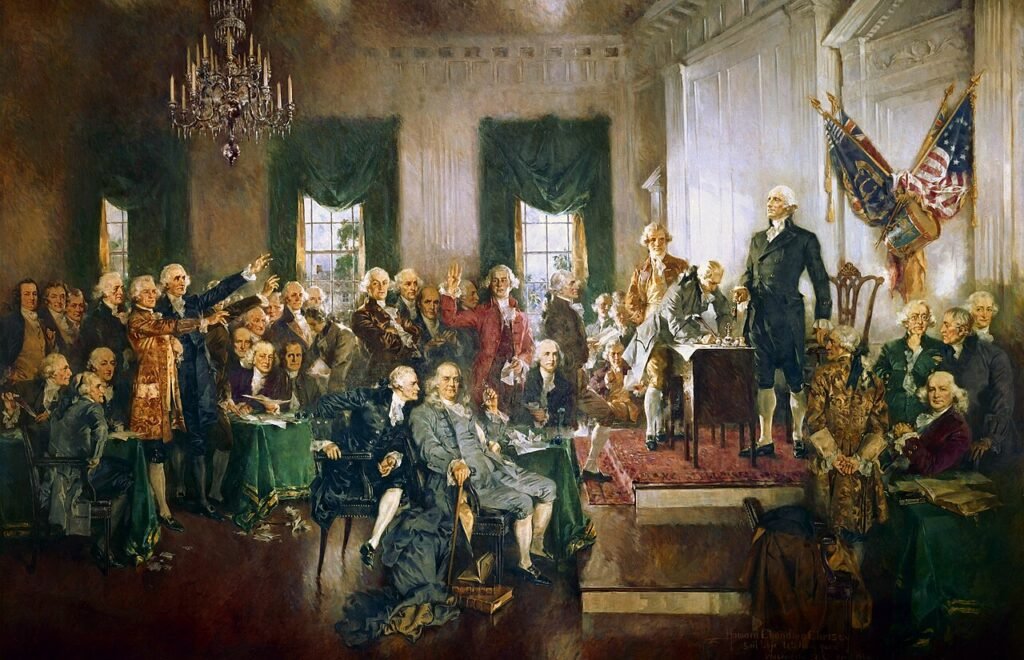
Article V constitutional convention painting 1787
When the framers drafted the United States Constitution in 1787, they faced a difficult problem. The new republic needed a system of government that was stable enough to endure for generations, but flexible enough to correct serious flaws when they emerged.
Their solution was Article V.
Article V establishes the constitutional process by which the Constitution itself may be amended. It reflects the founders’ understanding that no governing document can perfectly anticipate the future. Over time, circumstances change, institutions evolve, and political incentives shift. A constitutional system that cannot be corrected will eventually fail.
At the same time, the framers did not want constitutional change to occur easily or frequently. Amendments would require overwhelming national agreement, ensuring that the Constitution would remain stable while still allowing reform when necessary.
More than two centuries later, Article V remains one of the most important—and least understood—parts of the Constitution.
The Amendment Process
Article V provides two methods for proposing amendments to the Constitution.
The first and most familiar method allows Congress to propose amendments. If two-thirds of both the House of Representatives and the Senate approve a proposed amendment, it is sent to the states for ratification.
This method has been used for every amendment currently in the Constitution, including the Bill of Rights.
However, the framers did not want Congress to control the amendment process entirely. They recognized that the federal government might someday resist reforms that limit its own authority. If Congress alone could initiate amendments, necessary reforms might never occur.
For this reason, Article V includes a second method.
If two-thirds of the state legislatures—currently 34 states—submit applications calling for a convention to propose amendments, Congress is required to call such a convention.
This gathering is commonly referred to as an Article V Convention or a Convention of the States.
Importantly, such a convention cannot change the Constitution by itself. It can only propose amendments. Any amendment proposed by the convention must still be ratified by three-fourths of the states—currently 38 states—before it becomes part of the Constitution.
This ratification requirement ensures that constitutional changes require broad national agreement, not temporary political majorities.
Why the Convention Clause Exists
The convention mechanism was not an afterthought. It was added to the Constitution after delegates at the Constitutional Convention raised concerns about relying entirely on Congress to propose amendments.
George Mason of Virginia argued that Congress might never propose amendments that reduced federal power. If the federal government became oppressive or unresponsive, Mason warned, the people might have no peaceful way to reform the system.
His concern helped persuade the convention to include the state-driven amendment mechanism now found in Article V.
In this sense, the convention clause serves as a constitutional safety valve. It allows the states, acting collectively, to initiate amendments when the national government is unwilling or unable to act.
Why the Convention Has Never Been Called
Despite thousands of applications introduced in state legislatures over the past two centuries, an Article V convention has never been formally called.
In some cases, however, the threat of a convention has pushed Congress to act. Several constitutional amendments were proposed by Congress after large numbers of states began applying for a convention on specific issues.
Even so, confusion surrounding the process has made it difficult for states to coordinate their efforts. Over time, many states have submitted applications on different subjects, using different wording and different legal language.
As a result, there is ongoing debate about how these applications should be counted and whether they can be combined to reach the constitutional threshold.
The Problem of Fragmented Applications
The current patchwork of state applications creates uncertainty.
Some applications call for a convention on specific topics. Others request broader authority to consider amendments on multiple issues. Some were passed decades ago and remain technically active, while others have been withdrawn.
This fragmented approach allows Congress to claim that the requirements of Article V have not been clearly met.
Without clear, consistent language from the states, the convention mechanism becomes difficult to implement—even if large numbers of states believe reform is necessary.
A Proposal for a Standardized Convention Call
One possible solution is straightforward.
States that have previously submitted Article V applications could withdraw those applications and replace them with a new standardized resolution.
Such a resolution would use consistent language across multiple states, clearly stating that the legislature is applying for a convention to propose amendments under Article V of the Constitution.
A standardized application would serve several purposes.
First, it would remove ambiguity. Congress could no longer claim that the applications are too different to be counted together.
Second, it would create legal clarity. Identical or nearly identical applications would make it much easier to determine when the constitutional threshold of 34 states has been reached.
Third, it would allow states to coordinate their efforts in a deliberate and transparent way.
Rather than relying on a collection of unrelated resolutions passed over decades, the states could present a clear and unified request.
The Safeguards of Article V
Concerns are often raised about the possibility of a “runaway convention.” However, the structure of Article V provides several important safeguards.
Any convention called under Article V can only propose amendments. It cannot rewrite the Constitution or enact laws.
Most importantly, no amendment can take effect unless it is ratified by three-fourths of the states. This high threshold ensures that any proposed amendment must command overwhelming national support.
In practice, this ratification requirement makes it extremely difficult for radical or unpopular proposals to succeed.
A Constitutional Mechanism Waiting to Be Used
The framers did not design a constitutional system that depended entirely on the goodwill of Congress. They anticipated moments when the federal government might resist reform or become disconnected from the states and the people.
Article V provides a constitutional remedy for such moments.
For more than two centuries, the convention mechanism has remained largely unused. Yet it remains part of the Constitution, available to the states if they choose to act together.
Whether the states will ever coordinate to use this power remains an open question.
But the mechanism exists, written into the Constitution itself, waiting for the moment when the states decide that reform cannot come from Washington alone.
Leave a Reply